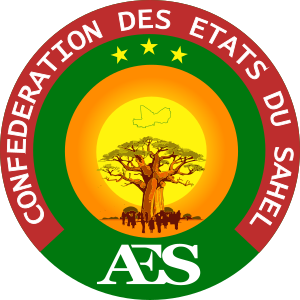
Emblem of the Confédération des États du Sahel

Liptako-Gourma Charter, September 2023

What the AES is

2023 to today

The Alliance of Sahel States (AES) joins Mali, Burkina Faso and Niger. Its founding text, the Liptako-Gourma Charter of 16 September 2023, began as a mutual defense pact against jihadist insurgencies in the tri-border zone.

All three came through coups: Mali in 2021, Burkina Faso in 2022, Niger in 2023. ECOWAS suspended them, and in January 2025 they withdrew, saying it served French interests. A Niamey summit on 6 July 2024 made the pact a confederation: a joint force of 5,000 troops, an investment bank, free movement, and a rotating presidency now held by Captain Ibrahim Traoré.

It is not socialist. It is a sovereigntist break with the CFA franc, French bases and export economies.

Berlin Conference, 1884

The scramble for Africa

1880 to 1960

Between 1880 and 1914 Europe divided Africa. Industry had outgrown the raw materials at home, so African territory supplied rubber, cotton, cocoa and minerals. The Berlin Conference of 1884 and 1885 set the rules with no African in the room.

Land was declared vacant and handed to concession companies. Forced labor lasted in French West Africa until 1946, with chiefs paid ten francs per worker sent to the railways.

Trading companies were the only buyers, so they set prices below world levels and kept the difference. Federico Tadei estimates monopsony and coercion cut African gains from trade by more than 60 percent. The CFA franc of 1945 held these states’ reserves in the French Treasury and set monetary policy in Paris.

Railways and ports carried raw materials out, never linking African economies to each other. Exporting commodities and importing manufactures became the basis of neocolonialism.

Union Soudanaise-RDA

Modibo Keïta and the Malian road

1960 to 1968

Modibo Keïta (1915 to 1977) was Mali’s first president after independence, 1960 to 1968, and a central figure in third-wave Pan-Africanism alongside Nkrumah, Touré and Lumumba. A teacher and socialist, he led the Union Soudanaise-RDA, organizing workers and peasants against colonial rule.

He wanted a West African federation that could pool resources, and was willing to trade sovereignty for it. The Mali Federation with Senegal became independent in 1960 and split the same year.

His program was state-led: nationalizations, state enterprises, a currency outside the CFA, campaigns in education and health. France withdrew technical assistance, sabotaged the currency and worked to destabilize him. Moussa Traoré overthrew him in 1968; he died in prison in 1977.

Leadership without an organized popular base stays exposed to coups outside powers are glad to support.

National Council of the Revolution

Thomas Sankara

1983 to 1987

Thomas Sankara (1949 to 1987) took power in Burkina Faso in August 1983 through a revolution led by junior officers and backed by mass organizations. A Marxist-Leninist, he rejected both capitalist development and Soviet bureaucracy. His method was the mass line: the Burkinabè would develop their own land.

He expelled French advisers and refused to repay the colonial debt. He nationalized land and minerals, carried out agrarian reform, rejected structural adjustment, ran vaccination campaigns that cut infant mortality, banned forced marriage and female genital mutilation, and backed liberation movements in South Africa and Palestine.

Blaise Compaoré killed him on 15 October 1987 and ruled for 27 years with French backing. Demonstrators carried his portrait when the 2014 uprising overthrew him.

He who feeds you, controls you.
Thomas Sankara, OAU summit, 1987

From defense pact to confederation

How the AES formed

2011 to 2024

Security

NATO’s 2011 intervention in Libya pushed weapons and fighters across the Sahel. Jihadist insurgencies spread from northern Mali into Burkina Faso and Niger, and neither Serval nor Barkhane could defeat them. French forces came to be seen as part of the problem; anger hardened into one demand: France must leave.

Legitimacy and the regional order

The coups of 2021, 2022 and 2023 drew mass support. ECOWAS, dominated by Nigeria, answered with sanctions and the threat of intervention in Niger, pushing the three capitals together. The Liptako-Gourma Charter answered that threat; the July 2024 treaty made the pact a confederation.

Unified force, mines, and the CFA franc

What the AES is doing

2024 to today

Security

The AES has a joint force of about 5,000 troops under a statute validated in July 2026. It has widened suppliers to Russia’s Africa Corps and Turkey, ending the French monopoly.

Jihadist violence keeps displacing people, and the armies have been accused of abuses. A military answer cannot settle a crisis rooted in poverty and colonial borders.

Resources and money

Mining codes were revised to raise revenue from gold and uranium, and 2024 and 2025 brought nationalizations. Niger has contested French control of the uranium that supplies French nuclear power.

The CFA franc is unresolved: all three remain in the zone and none has issued a currency of its own. The confederal bank and stabilization fund are small.

The contradiction

The AES is run by military officers, not a revolutionary party. Its anti-imperialism is real but nationalist. It is a progressive but unstable rupture: defend it against destabilization while organizing independently for deeper change.

Three scenarios and some tasks

The future of the Sahel

Scenarios

Consolidation

The AES survives pressure, builds its institutions, leaves the CFA and becomes a durable bloc. The risk is that it stays a militarized, top-down project and becomes state capitalism dependent on Russian or Gulf capital.

Rollback

France and its allies destabilize an AES state through proxies or sanctions, and a coup reverses it. Sovereignty without popular power is fragile.

Revolutionary deepening

Youth, workers and peasants push the governments left, toward land reform, workers’ rights and real participation. Nothing guarantees it.

Defend AES sovereignty without endorsing its governments wholesale. Keep Keïta and Sankara in circulation. Treat monetary sovereignty as a demand, not a technical question.

The AES is a moment in the Sahel’s anti-imperialist struggle, not its conclusion.